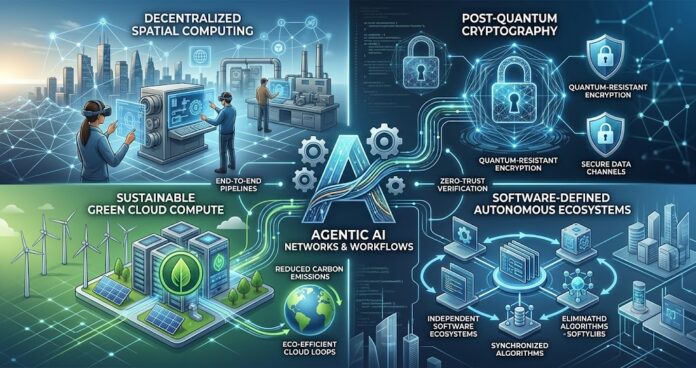
The latest technology trends changing businesses focus heavily on the maturity of autonomous agentic AI networks, decentralized spatial computing, software-defined quantum-resistant encryption, and sustainable green cloud compute loops. Rather than relying on simple, single-prompt chat software, modern enterprises build self-correcting business pipelines that run across distributed applications. This technical guide outlines how your company can adopt these fast-moving changes to maintain a clear competitive edge, eliminate software-based silos, and lower your operational overhead.
The Corporate Innovation Cheat Sheet
- Agentic AI Ecosystems: Digital workers are shifting from passive text engines into autonomous workflows that handle multi-step back-office jobs independently.
- The Post-Quantum Era: Companies are moving quickly toward quantum-safe cryptography to shield secure user data channels from next-generation cyber threats.
- Spatial Computing Integration: Augmented reality (AR) industrial overlays are fundamentally reshaping equipment repair, blue-collar field training, and digital retail spaces.
- Sustainable Infrastructure: Green cloud hosting models are now required to offset the heavy carbon footprint of running complex machine learning workloads.
1. The Shift to Agentic Workflows: Moving Past Basic Generative AI
When evaluating how the latest technology trends changing businesses operate, many companies run into a common roadblock. They treat advanced software as a basic tool for quick text drafts rather than a fully independent workforce.
The corporate world has moved far beyond simple browser chat windows. The modern gold standard relies on Agentic AI—intelligent software loops capable of making calculated decisions, executing multi-step tasks across different apps, and self-correcting mistakes without human guidance.
Autonomous Agents in the Back Office
In practice, deploying these smart agents alters standard corporate structures. Instead of an employee manually pulling raw sales numbers, organizing spreadsheets, drafting emails, and updating a CRM, a single agentic workflow connects to your core software tools to handle the entire chain autonomously. This frees up human employees to focus on creative strategy, client relations, and building new business value.
2. Head-to-Head Analysis: Core Disruptors and Operational Impacts
The table below breaks down the technical trends shaking up modern commerce, outlining their practical entry points and the key bottlenecks they help solve.
| Technology Trend | Primary Business Superpower | Practical Entry Point | The Operational Bottleneck It Solves |
| Agentic AI Networks | Self-correcting, multi-app background task automation | Customer service routing and automated supply chains | Removes human errors from boring, repetitive admin work |
| Quantum-Resistant Cryptography | Protects infrastructure against advanced decryption tools | Updating secure database transport layer security (TLS) | Stops cybercriminals from stealing encrypted corporate data |
| Industrial Spatial Computing | Overlays real-time digital instructions onto physical gear | Interactive staff training and remote field engineering | Cuts down expensive technician travel times and machinery downtime |
| Sustainable Green Cloud Compute | Minimizes carbon output using hardware optimized for eco-efficiency | Migrating data to server grids powered by clean energy | Avoids clean-energy compliance penalties and lowers power bills |
Expert Insight: When building a framework around these trends, remember that your data pipeline is only as strong as its foundation. Trying to run advanced autonomous software on top of a messy, unorganized internal database creates a serious bottleneck, leading to system glitches and flawed business metrics.
3. A Phased Integration Guide for Enterprise Leaders
Successfully rolling out these modern technologies requires a carefully planned, step-by-step approach. This prevents unexpected software downtime and gives your workforce plenty of time to adapt smoothly to the new tools.
1.Upgrade Security to Quantum-Resistant Standards:Phase 1.
Audit your corporate data channels. Transitioning your core databases to post-quantum encryption protocols ensures your data remains completely secure against emerging decryption methods.
2.Deploy Specialized Agentic Workflows:Phase 2.
Introduce autonomous digital workers to handle repetitive back-office tasks, like processing inbound supplier invoices, balancing digital ledgers, and managing low-level IT service tickets.
3.Expand into Interactive Spatial Training Platforms:Phase 3.
Equip your field workers with spatial hardware overlays. Displaying real-time repair schematics directly onto physical machinery speeds up training and slashes maintenance errors.
4. Protecting Corporate Systems Against Advanced Cyber Threats
As companies connect more automated tools and digital agents to their core databases, their overall digital attack surface expands significantly. Relying on basic password rules and legacy firewalls is a major vulnerability that leaves companies exposed to automated data-harvesting attacks.
[Legacy Perimeter Firewalls] ➔ Vulnerable to Automated AI-Driven Exploits ➔ Corrupts Core Databases
[Zero-Trust Micro-Segmentation] ➔ Continuous Identity Verification ➔ insulates Sensitive Corporate Data
Building a resilient modern business requires moving to a strict Zero-Trust framework. In practice, this means your network treats every user, device, and API request as potentially compromised.
By dividing your internal data networks into separate, secure segments and requiring continuous identity verification, you ensure that even if a single app gets breached, the rest of your proprietary corporate data stays completely safe. [Internal Link: Transitioning Enterprise Software to Zero-Trust Architecture]
5. Frequently Asked Questions (FAQ)
How exactly do autonomous agents differ from regular generative AI chatbots?
Traditional generative chatbots operate on a simple input-output model, requiring a human user to type a prompt for every single response. Autonomous agents utilize advanced logic loops that allow them to set their own sub-tasks, use external APIs to pull real-time data, and run multi-step workflows independently until they achieve the overarching business goal.
What is quantum-resistant cryptography, and why should businesses act now?
Quantum-resistant cryptography refers to advanced encryption algorithms engineered to withstand the processing power of upcoming quantum computers. Modern cybercriminals frequently capture and store encrypted corporate data streams now, intending to decrypt and exploit that information the moment powerful quantum hardware becomes widely available.
How does sustainable green cloud compute impact a company’s bottom line?
Running heavy machine learning workloads requires massive amounts of electrical power. Moving your data to eco-efficient cloud data centers reduces your carbon footprint, helps you comply with strict clean-energy regulations, and lowers your long-term energy costs through optimized hardware cooling designs.
Will spatial computing replace traditional screen setups for average office workers?
Not immediately. Spatial computing currently delivers its highest return on investment in industrial and hands-on sectors, such as manufacturing assembly, remote field repair, logistics navigation, and interactive surgical training, where workers benefit significantly from keeping their hands completely free. [Internal Link: The Real-World ROI of Industrial Spatial Computing Workspaces]
How can a mid-sized business compete with major corporations when adopting these trends?
Mid-sized businesses actually enjoy a distinct advantage: agility. While massive corporations struggle with slow bureaucratic approvals and clunky legacy mainframes, smaller teams can easily deploy lightweight, modular AI agents and open-source models to optimize their workflows in a fraction of the time.
6. Take Charge of Your Digital Evolution
Staying ahead in business isn’t about chasing every tech trend you see—it’s about choosing the right tools to solve your specific operational bottlenecks. By securing your data with post-quantum encryption, offloading tedious tasks to autonomous agents, and optimizing your infrastructure for sustainability, you build a resilient company ready for long-term growth. Pick your starting point, audit your current software stack, and upgrade your business operations today.

