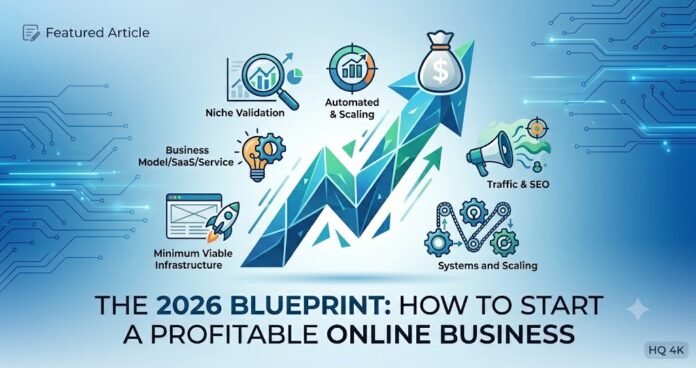
To learn how to start a profitable online business, you must validate a high-margin niche, choose a scalable monetization model like digital assets or B2B consulting, build a lean validation website, and drive targeted traffic via semantic SEO and data-driven direct outreach.
Key Takeaways for Fast Scaling
- Margin is King: Prioritize business models with 70% or greater net margins (software, info-products, or micro-agencies) to survive early cash flow gaps.
- Validate Before Building: Never spend weeks building an online store or product without securing pre-sales or hard intent data first.
- De-risk with Audience-First Assets: Build an email list or micro-community on day one. Relying solely on volatile algorithmic ad channels is a massive vulnerability.
- Systemize Admin Early: Use automated workflows for invoicing, client onboarding, and scheduling to keep your focus entirely on revenue-generating tasks.
1. The Real Reason Most Online Businesses Never Make a Profit
The web is flooded with generic advice on how to start a profitable online business. Most tutorials tell you to pick a product, spin up a Shopify store, and run paid social ads. When deploying this outdated strategy, founders usually hit a bottleneck: rising customer acquisition costs (CAC) wipe out their thin margins.
To build a genuinely sustainable internet business, you must focus on unit economics from the start. Profitability isn’t just about total sales volume. It is about keeping your operational overhead low and your customer lifetime value (LTV) high.
High-Profit vs. High-Risk Models: The 2026 Breakdown
| Online Business Model | Average Net Margin | Time to First Dollar | Primary Bottleneck | Upfront Risk |
| B2B Micro-Agency | 70% to 85% | Fast (1 to 3 weeks) | Client acquisition capacity | Exceptionally Low |
| Digital Products & SaaS | 85% to 95% | Slow (1 to 3 months) | High initial building time | Low to Medium |
| Traditional E-commerce | 15% to 25% | Medium (2 to 4 weeks) | Supply chain & ad fatigue | High |
| Affiliate Content Hub | 40% to 60% | Very Slow (6+ months) | Algorithmic traffic volatility | Low |
Expert Insight: In practice, the fastest path to profitability is selling expertise or digital assets. Physical logistics involve inventory depreciation, return processing fees, and shipping variables that kill beginner cash flow.
2. Phase 1: Micro-Niche Validation and Market Selection
If you target everyone, you end up converting no one. Beginners often select massive markets like “fitness” or “finance.” These spaces are heavily defended by legacy brands with multi-million dollar budgets.
Instead, look for market gaps where customers have a highly specific, urgent pain point. We call this finding a profitable micro-niche.
The Niche Validation Framework
- Identify the Burning Problem: Does the target audience lose money or time because of this issue?
- Analyze Purchasing Intent: Are they already paying for suboptimal tools, software, or freelancers to patch the problem?
- Verify Accessibility: Can you get in front of these decision-makers directly via search terms, specialized forums, or professional networks?
[Broad Niche: Marketing] ➔ [Sub-Niche: Email Marketing] ➔ [Micro-Niche: Email Funnels for Eco-Friendly SaaS]
By owning a specific micro-niche, your marketing message becomes incredibly sharp. You instantly transition from a commoditized vendor to a premium specialist.
3. Phase 2: Building Your Minimum Viable Infrastructure
A common trap for new digital entrepreneurs is spending months obsessing over logos, business registration paperwork, and complex tech stacks before making a single sale.
When establishing your infrastructure, your core objective is to create a frictionless environment where a prospect can understand your offer and pay you immediately. Keep your setup incredibly lean.
1.Secure a Keyword-Exact Domain:Day 1.
Buy a clean .com domain name that clearly indicates what your business does. Avoid confusing spellings or excessive hyphens.
2.Deploy a High-Conversion One-Pager:Days 2–4.
Build a single landing page using a fast, clean framework. Your page must feature a compelling headline, a clear breakdown of benefits, social proof or portfolio pieces, and a clear contact or order form. [Internal Link: High-Converting Landing Page Design]
3.Integrate a Clean Payment Processor:Day 5.
Set up a business account with a secure processor like Stripe or PayPal. Ensure you can generate direct payment links or professional invoices within seconds.
4. Phase 3: The Profitability Engine — Organic and Direct Traffic
Once your digital doors are open, your survival depends entirely on your traffic strategy. Do not rely heavily on paid Facebook or Google ads when you are bootstrap-funding. If your conversion rates are unoptimized, paid acquisition channels will quickly burn through your startup capital.
Building Topical Authority with Semantic SEO
To secure consistent, passive leads, you must optimize your content for modern search intent. This means organizing your site around deep topical clusters rather than spamming individual keywords.
Write authoritative guides that fully break down secondary concepts, include original data tables, and address real-world edge cases. When search engines recognize your site as a comprehensive resource, your primary pages will rank significantly higher.
High-Converting Acquisition Channels
Organic Search Traffic (Long-term Stability) ──┐
├──> [High-Converting Landing Page] ➔ [Sales Conversion]
Personalized Direct Outreach (Instant Cash) ───┘
- Warm Direct Outreach: Find business owners who explicitly need your services. Send short, highly personalized pitches demonstrating exactly how you can patch their operational gaps.
- Value-First Content Distribution: Share actionable insights inside niche communities where your target clients hang out. Do not pitch your services directly; simply show your expertise by answering complex technical questions.
Pro Tip: A common bottleneck is waiting passively for organic SEO to kick in. Combine your long-term organic strategy with active direct outreach to bring in quick revenue during your first thirty days.
5. Phase 4: Systems, Automation, and Scalability
To transition from a stressful freelance setup to a true, self-sustaining online business, you must decouple your time from your revenue generation. This requires aggressive systems building and workflow automation.
Streamlining Recurring Deliveries
If you run a service-based agency, productize your delivery. Instead of writing unique proposals for every prospect, sell standardized packages with fixed scopes, explicit pricing, and predictable delivery times.
[Inbound Form Submission] ➔ [Atomated Onboarding Email] ➔ [Task Generated in Project Tool]
Use automation tools to link your intake forms directly to your internal project boards. When a client pays an invoice, your system should automatically spin up their client portal, send a welcome questionnaire, and cue up the necessary initial tasks without requiring your manual intervention.
6. Frequently Asked Questions (FAQ)
What is the most profitable online business model for beginners?
The most profitable online business model for absolute beginners is a B2B service agency or digital asset business. These setups boast minimal overhead costs, require zero physical inventory management, and generate immediate cash flow that can be reinvested into long-term scaling.
How much money do I need to start an online business?
You can start a profitable online business with less than $100. This minimal budget covers your domain name acquisition, basic web hosting, and an email marketing platform seat. By utilizing free invoicing tools and relying on organic traffic or direct outreach, you can avoid early debt.
How long does it take for an online business to become profitable?
A lean, service-based online business can achieve true profitability within 14 to 30 days if you leverage direct outreach strategies. Asset-heavy or content-driven businesses, like traditional e-commerce stores or large affiliate blogs, typically take 3 to 6 months to offset their initial setup and ad costs.
Do I need a formal business degree to start an online business?
No, a formal business degree is absolutely unnecessary. Modern digital platforms have democratized online commerce. Success relies entirely on your ability to solve a specific problem for a targeted group of buyers and execute practical skills like copywriting, technical optimization, and basic project management.
How do I protect my online business from losing traffic to AI search engines?
To safeguard your traffic from changing search engine algorithms, focus on deep information gain. Publish original case studies, include proprietary data tables, share direct video tutorials, and build a dedicated email newsletter list so you own your audience data directly. [External Link: Google Search Central E-E-A-T Framework]
7. Turn Your Strategy into Reality Today
The single biggest roadblock to starting a profitable online business is passive analysis paralysis. Planning is comfortable, but actual execution is what moves the needle. Pick your micro-niche, set up a simple payment route, and start reaching out to prospects. Your path to digital independence begins the moment you put your offer into the market.

